What If You’re Part of the Problem?
I wrapped up a coaching engagement this week, and I asked my client a simple question:
“What was most helpful about our coaching together?”
Her answer made me proud.
She said, “Our conversations made me really grow as a leader. But more importantly, I realized an important life lesson. Sometimes I am half of the problem.”
I was blown away by her self-awareness and the courage it took to share this profound realization.
Why It’s Easier to See What’s Wrong in Others
In life, it is always easy to see what others are doing wrong.
It’s easy to notice when others are not communicating well.
When your peer’s team is slow to get things done.
When the other team is not being collaborative.
When someone else just does not get it.
But what happens when you stop and ask yourself:
“What part of this might be mine?”
Let me provide you with some context.
My client was dealing with an ongoing conflict with a peer. This was a person that she used to be friends with. However, they were both strong leaders. They both wanted results and, as she put it, “We both wanted to win.”
That’s often where peer conflict gets stuck.
You’re both trying to get the best outcome for your team, but you start defending your position instead of solving the problem together.
What Changed When She Stopped Trying to Win
So, I asked her what happened when she realized she was part of the problem.
Her answer?
“I let go of my ego.”
She explained to me that she decided to be more helpful to his team. She stopped thinking that there was only one way to solve their problems. She also stopped complaining about him to her team.
Then something interesting happened.
They became friends again.
The relationship changed because she changed.
It was not because she convinced him that he was wrong.
It was not because he changed his communication style.
It was definitely not because one of them “won.”
She put her ego aside enough to ask:
“What would it look like for us to create a win-win situation?”
That opened up a very different conversation.
Together, they looked at:
- What’s working between their teams?
- What’s not working?
- What can we do differently moving forward?
She made the important shift from thinking about “me” to thinking about “we.”
Taking Responsibility for Your Part
You don’t have to take responsibility for the entirety of a conflict.
But what if you took responsibility for your half?
That’s where things can start to change.
Questions to Ask Yourself the Next Time You’re in Conflict
The next time you are stuck in conflict with a peer, ask yourself:
- What am I contributing to this situation?
- Where might my ego be getting in the way?
- What would a win-win actually look like?
- What can I do differently even if they don’t change?
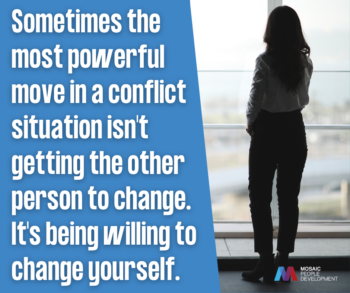
Sometimes the most powerful move in a conflict situation isn’t getting the other person to change.
It’s being willing to change yourself.
Thank you for sharing!
If you found this article helpful, please click the links below to share it on your favorite platform.