
Is Your Door Really Open?
“I have an open-door policy.”
I hear leaders say this all the time.
But recently, I was reading a discussion on LinkedIn where someone made a great point by stating that, “An open-door policy means very little without psychological safety.”
And they’re right!
Why an Open Door Isn’t Enough
Just because a door is physically open doesn’t mean people feel comfortable walking through it.
In fact, many employees won’t speak up if they think they will be judged, criticized, ignored or seen as a problem.
I was reminded of this during a recent conversation that I had with an Executive.
He told me, “Vanessa, my team never brings me issues until they’re big problems.”
When I spoke with some of his team members, I discovered something interesting.
They all respect him and think that he is smart and hardworking. However, they are hesitant to raise concerns because every time they bring up a problem, he immediately jumps into solution mode.
His intentions are good and he wants to help.
So, what is the problem?
Well, his team always feels rushed when they approach him. They feel like they aren’t fully heard. So, over time, they stopped bringing up issues to him altogether.
That’s when it hit him.
His door is open.
But psychologically, it didn’t feel safe to walk through.
This realization is a game-changer!
The reality is that psychological safety is not created by a policy or how quickly you resolve issues.
It’s created, in part, by a leader’s response to issues and concerns.
The Questions Your Team Is Silently Asking
When your team comes to speak to you, they are constantly asking themselves:
- Can I speak honestly here?
- Can I disagree respectfully?
- Can I admit a mistake?
- Can I bring bad news?
- Will I be listened to without being criticized or rushed?
The answers to those questions determine whether people speak up.
This becomes even more important in today’s hybrid and virtual workplaces.
Years ago, employees could pop into a leader’s office, catch them in the hallway or read their body language during a conversation.
Today many teams communicate through screens, emails and instant messages.
The “door” isn’t even visible anymore.
How to Create a True Open-Door Policy
So how can you create a true open-door policy in a virtual or hybrid environment?
Here are a few ideas:
- Be intentionally accessible. Don’t make people wait weeks for a conversation. Create office hours, regular check-ins, or opportunities for informal conversations.
- Respond calmly to bad news. The fastest way to shut down communication is to punish the messenger. Thank people for bringing issues forward, even when the message is difficult.
- Get curious before solving. Instead of immediately jumping into advice, ask questions. Help people feel heard before moving to solutions. When everyone agrees with the boss, something is usually missing. Ask, “What am I not seeing?” or “Who has a different perspective?”
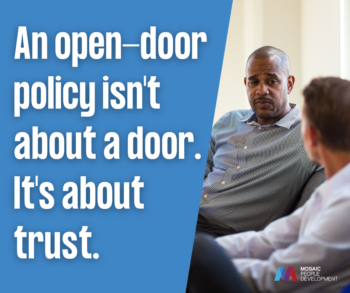
An open-door policy isn’t about a door. It’s about trust.
It’s about creating an environment where people feel comfortable bringing you their concerns, ideas, mistakes and challenges before they become bigger problems.
When people feel psychologically safe, they don’t need to be invited through the door.
They walk through it willingly.
Thank you for sharing!
If you found this article helpful, please click the links below to share it on your favorite platform.