
Under Pressure: How Is Your Stress Impacting Others?

Have you noticed how much pressure people are under these days?
One of the things I appreciate about my role is that I get to work with leaders across many different industries and organizations. This gives me a bird’s-eye view of what’s happening in the workplace.
Lately, I am noticing a common theme.
People are feeling a tremendous amount of pressure.
Whether it’s the pressure to deliver results, manage increasing workloads, navigate change or do more with fewer resources, leaders are feeling stretched.
I’m hearing it everywhere.
In fact, I’ve been thinking so much about this topic that I’m developing some new content to help leaders manage pressure more effectively. Feel free to reach out if you are interested in learning more.
In the meantime, I want to share a few thoughts and a simple model I’ve created that I think will help you.
Pressure Changes the Way You Lead
Here’s something I’ve noticed over the years.
When leaders are under pressure, their behaviour changes.
Think about your last really difficult week at work.
Maybe you were dealing with competing priorities, a challenging employee, an unhappy customer or a deadline that seemed impossible to meet.
Now ask yourself:
What three words would your team use to describe your behaviour that week?
Would they say you were calm, approachable and supportive?
Or would they describe you as impatient, reactive or distracted?
It’s an interesting question, isn’t it?
Because while you’re busy dealing with everything that’s on your plate, your team is experiencing the impact of your behaviour.
And sometimes, without even realizing it, you may be adding to their stress.
Are You Under Pressure or Above Ground?
In my work with leaders, I often see two very different ways people respond to stressful situations.
I’ve created a simple model to help explain this.
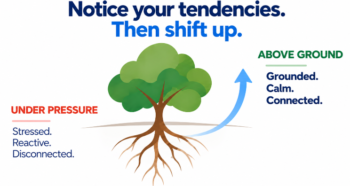
1. Under Pressure: The Pressure Drives Your Response
When you’re under pressure, you may become:
- Stressed: You’re overwhelmed, worried or frustrated.
- Reactive: You respond quickly, sometimes without thinking about the impact of your words or actions.
- Disconnected: You’re so focused on the problem that you lose sight of the people around you.
In this state, the pressure is driving your behaviour.
You may become more controlling, impatient or critical. Or perhaps you withdraw, avoid difficult conversations or stop communicating.
Whatever your tendencies, the people around you feel the impact.
2. Above Ground: You Choose Your Response
When you’re above ground, you are:
- Grounded: You have perspective and don’t let every challenge throw you off balance.
- Calm: You manage your emotions rather than allowing them to manage you.
- Connected: You stay engaged with the people around you, even when things get difficult.
Notice that being above ground doesn’t mean the pressure disappears.
You still have the same deadlines, challenges and responsibilities.
The difference is that you are choosing how to respond rather than allowing the pressure to choose for you.
And that makes a tremendous difference to the people you lead.
Notice Your Tendencies. Then Shift Up.
The first step to managing pressure is recognizing what it does to you.
We all have tendencies that show up when we’re stressed. Some people become controlling. Others avoid difficult situations. Some try to please everyone, while others become perfectionists.
The key is to recognize your own patterns.
The next time you’re feeling under pressure, ask yourself:
- What am I feeling right now?
- How is this pressure impacting my behaviour?
- What are the people around me experiencing?
- What can I do to shift from being reactive to being more grounded, calm and connected?
Sometimes, simply noticing your behaviour is enough to help you make a different choice.
You might need to pause before responding to a frustrating email. Take a few minutes to collect your thoughts before a difficult meeting. Or stop and really listen to someone instead of rushing to solve their problem.
These are small shifts. But they can have a big impact.
Your Leadership Challenge This Week
Pressure is inevitable. We can’t eliminate it from our work or our lives.
But we can become more aware of how we respond to it.
So, here’s my challenge to you this week.
Pay attention to your behaviour when you’re feeling stressed.
Notice when you slip below ground. And when you do, ask yourself what you need to do to shift up.
Remember, your team is watching how you respond, especially when things get difficult.
You may not be able to control the pressure you’re experiencing, but you can control how you show up for others.
Don’t let your pressure become everyone else’s pressure.
That’s an important part of being an effective leader.
Thank you for sharing!
If you found this article helpful, please click the links below to share it on your favorite platform.