
The 5 Behaviours That Build Trust With Your Team
Think about one of the best leaders that you’ve ever worked for in your career.
Chances are, one of the reasons they stood out was because you trusted them.
Trust is the foundation of every high-performing team. Yet, so many leaders underestimate how much their daily behaviour either builds trust or quietly chips it away.
According to Gallup’s 2026 State of the Global Workplace report, employees in poorly managed, low-trust companies are nearly 60% more likely to experience stress than those with strong leadership.
A lack of stress means more focus, better collaboration and stronger results. Building trust isn’t a “nice to have.” It directly affects how well your team performs.
So how do you actually build a high-trust team?
Trust Is Built in the Small Moments
One of the biggest misconceptions I see in my coaching work is that leaders think trust is built through big gestures like a town hall speech or a team offsite. But that’s not really how it works.
Trust is built in the small, consistent, everyday moments. It’s the meeting you showed up to on time, the commitment you followed through on or the hard conversation you didn’t avoid.
In fact, I just spoke to a client who told me that her boss cancels their one-on-one meetings all the time. This one action makes her feel unimportant, demotivated and removes trust from their relationship.
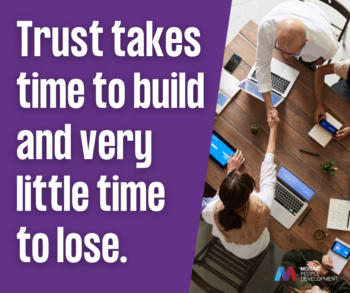
Trust takes time to build and very little time to lose.
That’s why consistency matters more than intensity.
So, what can you specifically do to build a high-trust team?
Here are 5 Behaviours That Build Trust:
1. Lead by example.
If you expect your team to be on time, prepared or accountable, you have to model these behaviours first. Your team is always watching. What you do speaks louder than what you ask of them.
2. Do what you say you’re going to do.
This one is non-negotiable. If you commit to something, it is critically important that you follow through. If circumstances change, ensure that you communicate early. Nothing erodes trust faster than a leader who says one thing and does another.
3. Be honest and transparent.
Avoiding difficult conversations doesn’t protect your relationships. If fact, the opposite is true. It damages them. When you sidestep feedback or withhold important information, your team notices. Be courageous. Say the hard things. Your team will respect you for it.
4. Own your mistakes.
Leaders who admit when they’re wrong build more trust than those who never seem to make errors or own their mistakes. When you take responsibility, you signal to your team that it’s safe for them to do the same. That kind of culture is powerful.
5. Be respectful consistently.
This should go without saying, but it’s worth naming. Behaving poorly and then apologizing isn’t a strategy. It creates anxiety and uncertainty within your team. Respect isn’t something that you can turn on and off.
The Formula Is Simple
Consistent behaviour leads to trusting relationships.
Trusting relationships lead to high-performing teams.
A team without trust isn’t really a team. It’s a group of individuals working side by side.
When trust is present, people go above and beyond, have each other’s backs and do their best work.
That’s what leadership is really all about!
Thank you for sharing!
If you found this article helpful, please click the links below to share it on your favorite platform.